
The World War Take Over 🌍🌏🌎 Sovereign Immunity Series Part 1 of 5
WORLD WAR ONE Made it possible for a new kind of bank to assume total control of the world's financial system.

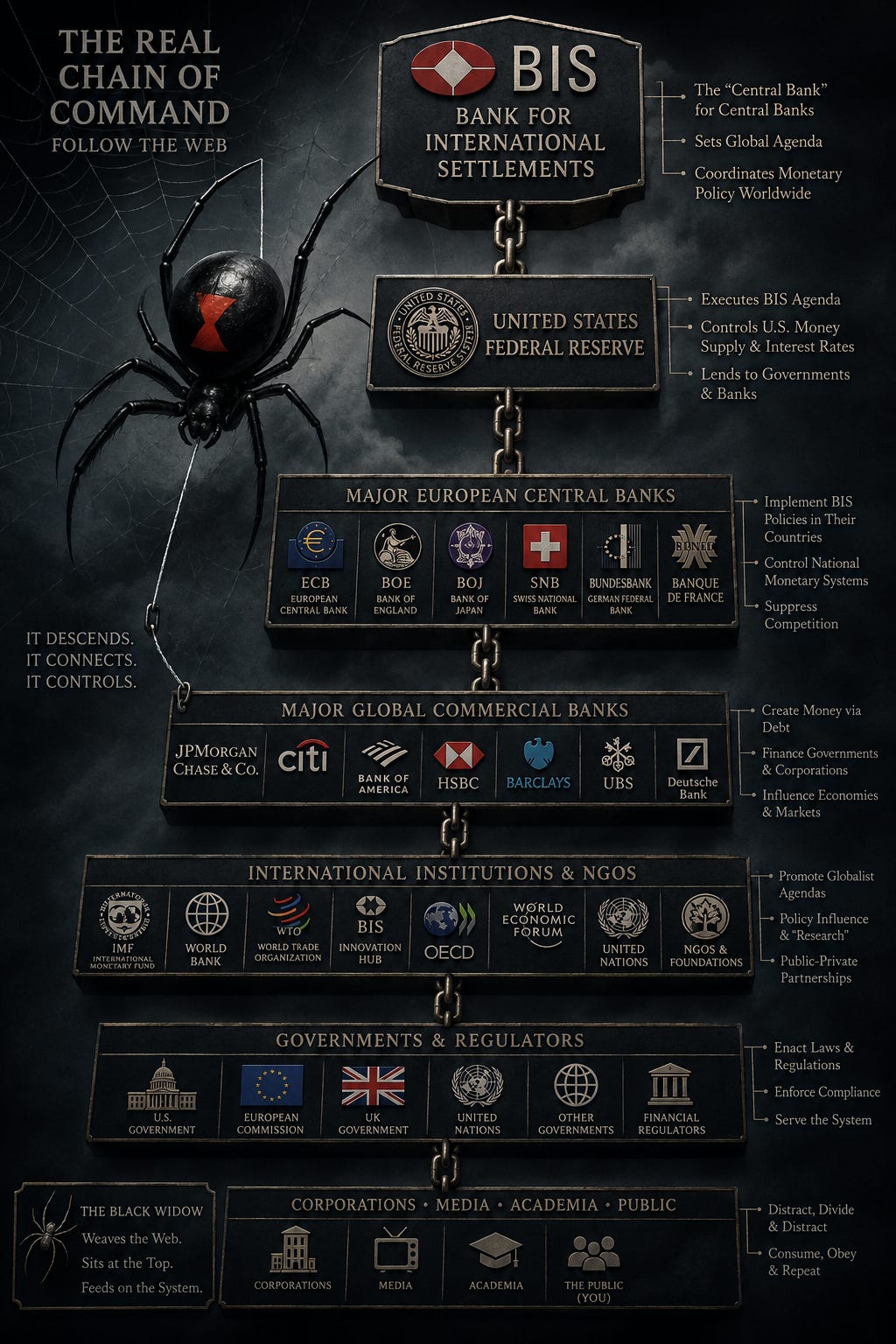
The Sovereign Immunity Series follows one bank through a hundred years of war, bailout, historical origins and quiet rule-writing. Five parts. One untouchable bank. The story your textbook left out.
We start with the definition.
Sovereign Immunity 🔥
noun. The legal doctrine that a sovereign entity cannot be sued, taxed, searched, seized, or held accountable in any national court without its own consent. Originally a privilege of kings. Now a privilege of one bank in Basel, Switzerland.
The Sovereign Immunity Series Navigation
Part 1 => Part 2 => Part 3 => Part 4 => Part 5
Most people think sovereign immunity belongs to nations. Kings claimed it. Modern states inherited it. Embassies and diplomats borrow a thinner version of it. But there is exactly one private bank on earth that holds it in full. Its building cannot be entered without permission. Its assets cannot be seized in peace or in war. Its officers cannot be prosecuted for their official acts. Its records cannot be subpoenaed by any court anywhere. It pays no taxes. It answers to no parliament.
Here is the detail that changes everything. This bank was not chartered like a normal corporation. It was created by international treaty. The Hague Convention of January 1930, signed by Belgium, France, Germany, Italy, Japan, the United Kingdom, and Switzerland, brought it into being. A Swiss corporate charter could be revoked, taxed, sued, or rewritten by the Swiss parliament. A treaty cannot. That single legal distinction, treaty-born rather than charter-born, is the foundation on which every later layer of immunity was built. The 1936 Brussels Protocol added more. The 1987 Headquarters Agreement with Switzerland added more again. Every host country agreement signed since, from Singapore to Canada, has been required to renew the same package. The bank predates the IMF, predates the World Bank, and predates the United Nations. And it sits above all of them in legal protection.
This is the story of how one neutral balance sheet, hidden behind the oldest legal shield in human civilization, quietly cleared Nazi gold, Soviet bullion, and the largest dollar bailout in history. And why no court on earth has ever opened its books.
This is Part 1 of a five-part series. The other four go deeper into the moments where this institution shaped history. The Civil War supply chains that taught the world how to fund both sides of a former colony’s war. The 2008 bailout the textbooks still describe wrong. The unwritten rules that decide who actually runs the global financial system. And the next architecture being built right now under the name Project Nexus. Start here. The full map lives in this piece.
🌍 The backstory: a treaty bank for central banks born from defeat
The Bank for International Settlements opened its doors on May 17, 1930, in Basel. Its founding mission sounded almost noble. Manage Germany’s World War I reparations under the Young Plan. Give the world’s central banks a quiet, neutral parlor in which to coordinate. Stand above politics.
Its birth was not ordinary. The concept was agreed at The Hague Conference in August 1929. The Convention, Charter, Statutes, and the Convention respecting the Bank’s relations with the host country were drafted in Baden-Baden by a special Organisation Committee chaired by Jackson Reynolds, president of the First National Bank of New York. The Swiss Federal Council approved them on February 26, 1930. That approval gave the documents force of law inside Switzerland and force of treaty between the signatories. Belgium, France, Germany, Italy, Japan, the United Kingdom, the United States, and Switzerland signed on. Basel was chosen for two virtues. Swiss neutrality and excellent rail connections.
From the start, the BIS was unusual. Because it was treaty-born, it held diplomatic immunity from inception. It sat outside Swiss tax law. Its assets were declared immune from seizure or confiscation in peace or in war. That clause, written in 1930, would matter more than its drafters dared imagine.
By 1939, neutrality had become a shield for contradiction. The BIS claimed to be apolitical, even as Nazi Germany sat at its table, sent gold through its vaults, and used its transfers to buy the materials it needed to wage war.
Between 1938 and 1940, according to BIS records, the bank helped move more than 140 tonnes of gold to New York. It continued to process remittances, receive payments from the Reichsbank, and operate through the entire war.
📆 Zero to Hero arc: receipts, not rumors
Who was in the room:
BIS Board, June 1941 (ranked top to bottom by institutional power)
Chair of the Board
VACANT (the Chair seat sat empty from May 1940 to December 1942)
President of the BIS (chief executive and Board member)
Thomas H. McKittrick (United States), effectively chairing the institution with the Chair seat vacant
Vice-Chairs of the Board
Alexandre Galopin (Belgium)
Hisaakira Kano (Japan)
Directors (Board members)
Walther Funk (Nazi Germany, Reichsbank President)
Montagu Norman (United Kingdom, Bank of England Governor)
Sir Otto Niemeyer (United Kingdom)
Yves Bréart de Boisanger (France, Bank of France Governor)
Baron Brincard (France)
Marquis de Vogüé (France)
V. Azzolini (Italy, Bank of Italy Governor)
Francesco Giordani (Italy)
Hermann Schmitz (Nazi Germany, IG Farben CEO)
Kurt von Schröder (Nazi Germany, J.H. Stein Bank)
L. J. A. Trip (Netherlands)
Ivar Rooth (Sweden, Riksbank Governor, future second IMF Managing Director)
Ernst Weber (Switzerland, future Chair from Dec 1942)
Yoneji Yamamoto (Japan)
Alternate Directors
Emil Puhl (Nazi Germany, Reichsbank Vice-President)
Cameron Cobbold (United Kingdom, future Bank of England Governor)
Adolphe Baudewyns (Belgium)
Giovanni Acanfora (Italy)
Mario Pennacchio (Italy)
General Manager (top day-to-day executive)
Roger Auboin (France)
Other executive officers
Paul Hechler (Germany, Assistant General Manager)
Raffaele Pilotti (Italy, Secretary General)
Per Jacobsson (Sweden, Economic Adviser, future third IMF Managing Director)
Marcel van Zeeland (Belgium, Manager)
Felix Weiser (Manager)
Look at that wartime board roster one more time. Three of its members would go on to lead the IMF in succession. Camille Gutt of Belgium, the first Managing Director from 1946 to 1951. Ivar Rooth of Sweden, the second from 1951 to 1956. Per Jacobsson of Sweden, the third from 1956 to 1963. The institution the Allies voted to dissolve at Bretton Woods produced the first three chiefs of the institution that was supposed to replace it.
BIS Board, June 1942
Mostly unchanged. Same Axis, Allied, and neutral directors sitting at the same table while their armies killed each other across three continents. Chair seat still vacant. McKittrick re-elected President with German acquiescence.
And Japan was there too. While the Axis ransacked continents, Japan kept its seat at the BIS board table. Hisaakira Kano and Yoneji Yamamoto served as official Japanese representatives throughout 1941 and 1942 and beyond. Even as Japan invaded China, attacked Pearl Harbor, and joined the Axis pact, its central bankers remained part of the same network that enabled Nazi gold to flow. Neutrality, it seems, included everyone.
BIS Board, September 1945 (ranked top to bottom)
Chair of the Board
Ernst Weber (Switzerland, Swiss National Bank President)
President of the BIS
Thomas H. McKittrick (United States, remained through June 1946)
Directors
Lord Catto (United Kingdom, Bank of England Governor)
Sir Otto Niemeyer (United Kingdom)
Emmanuel Monick (France, Bank of France Governor)
Baron Brincard (France)
Marquis de Vogüé (France)
Luigi Einaudi (Italy, Bank of Italy Governor, future President of Italy)
Maurice Frère (Belgium, National Bank of Belgium Governor)
Camille Gutt (Belgium, future first IMF Managing Director)
L. J. A. Trip (Netherlands)
Ivar Rooth (Sweden, Riksbank Governor, future second IMF Managing Director)
Notice what changed and what didn’t. The German and Japanese directors are gone. The American president stayed. Several Allied names quietly replaced the Axis seats. The institution kept running without missing a meeting.
What the BIS did:
In March 1939, just after Germany seized Prague, BIS processed a transfer of Czech gold held in London to the Reichsbank, on German orders. The Bank of England executed the transaction. The BIS continued to accept Reichsbank interest remittances, largely in gold, throughout the war. The bank also received looted gold from Belgium and the Netherlands, according to its own 1997 retrospective. A portion of that gold was later returned in postwar restitution.
Why it mattered: BIS enabled Germany to convert looted gold into spendable reserves. Those reserves paid neutral countries like Sweden and Portugal for iron, tungsten, and machinery. Without that trade, the Nazi war machine could not have maintained its military campaigns.
Which means this. The fuel and metal that powered the Blitz traveled through a supply chain whose financial settlements depended on a neutral bank run by American, British, and Nazi-aligned executives.
🕵️ The McKittrick paradox
There is one piece of this story that complicates the easy moral. Thomas McKittrick, the American President of the BIS through the entire war, was simultaneously cooperating with U.S. intelligence. Allen Dulles, the OSS station chief in Bern, met with McKittrick during the war years. McKittrick passed information about German finance, Reichsbank movements, and Axis economic conditions to U.S. officials.
That detail does not weaken the indictment of the institution. It strengthens it. Even when one of the central bankers was actively working with American intelligence, the institutional machinery kept processing Reichsbank gold anyway. McKittrick personally could pass notes to Dulles by night and approve Reichsbank interest payments by day, because the BIS was bigger than any one director’s conscience. The structure ran itself. The treaty-born immunity protected the structure. The structure protected the flows.
⚠️ Raising the stakes: no BIS, no Blitz
By the BIS’s own records, Reichsbank gold payments were received and disbursed to cover investments and obligations during the war. That gold was not symbolic. It paid for steel, oil, optics, and locomotives. The planes that bombed London depended on those materials.
If BIS had refused remittances, or if it had frozen Reichsbank accounts in 1939, Germany’s access to neutral markets would have choked. It might have slowed or even prevented the Blitz.
The BIS would later argue, with some legal merit, that its 1930 statutes required it to honor transactions for member central banks and that it had no charter authority to freeze Reichsbank accounts unilaterally. That defense is technically true. It also dodges the harder question. Every other Allied institution rewrote its rules of engagement when war broke out. The BIS did not. Its board kept meeting. Its president kept signing. Its books kept balancing. Neutrality was not a passive condition. It was a choice to keep the machinery running for a regime looting Europe.
🔫 The Enfield rule: bankers don’t care who pulls the trigger
To understand the BIS, you have to understand a much older British habit.
During the American Civil War, the Union Army marched into battle carrying the Pattern 1853 Enfield rifle, manufactured in Birmingham, Liverpool, and London. So did the Confederate Army. Roughly 900,000 Enfields crossed the Atlantic between 1861 and 1865, in roughly equal numbers to each side. The same factories, the same gunsmiths, the same insurance underwriters in the City of London profited from every volley fired in both directions.
And it was not just rifles. The Confederate grey wool kersey called English Army Cloth was woven in British mills. The Union blue was supplemented by imported European wool, much of it British. The same Yorkshire and Lancashire looms that wove cloth for Richmond also fed cloth into Union contracts. A Union soldier in blue and a Confederate soldier in grey, lying dead in the same Tennessee field, were often killed by rifles stamped with the same English proof mark, while wearing wool spun on the same English looms, paid for with cotton picked by the slaves the Union was fighting to free. Three layers of the same supply chain wrapped around both corpses. The British Treasury did not lose a shilling on any of it.
This is the deepest law of international finance. Capital does not pick a side. It picks a flow. The shareholders of a Birmingham gun works, a Yorkshire wool mill, and a Liverpool insurance house got paid whether Antietam went blue or grey. The City of London ran the war from both ends and balanced the books at Christmas.
The BIS in 1940 was simply this old British habit wearing a Swiss suit. Reichsbank gold in, Swedish iron out, German bombers up, London on fire, and the ledger balanced at the end of every quarter. Walther Funk sat on the board. So did Montagu Norman of the Bank of England. They sat on the same board, signing the same minutes, voting on the same resolutions, even as their countries were killing each other’s young men. The Enfield rule had simply moved one floor up the building, from arms to currency.
This is uncomfortable. It is also clarifying. Once you see the pattern, you stop being surprised by it. You start looking for it. And you start finding it everywhere.
Available Now👇
🧬 The Cold War proof: the BIS quietly banked the Soviets too
If anyone still doubts that the BIS serves capital first and ideology never, the Cold War settled the question.
The Soviet Union was one of the largest gold producers on earth. Gosbank, the Soviet central bank, needed Western currency to import grain, machinery, and technology. So it sold gold. Quietly. Through Basel.
The BIS became the preferred venue for Moscow to liquidate gold reserves into dollars, pounds, and Swiss francs, far from the political theater of the United Nations. Communist gold went in, capitalist currency came out, and not a single newspaper headline disturbed the transaction.
Then came the Eurodollar market. In the 1950s and 1960s, the Soviet Union and its Eastern Bloc satellites were terrified to park their dollar earnings in New York. One stroke of a U.S. Treasury pen could freeze the accounts. So they moved their dollars to London and Paris instead, where U.S. regulators could not reach them. That communist nervousness gave birth to the Eurodollar, an offshore pool of U.S. currency outside the Federal Reserve’s control.
The BIS did not flinch. It studied the Eurodollar market, mapped it, embraced it, and effectively became its monitoring agency. Communist dollars fueling capitalist liquidity, supervised by a bank chartered by capitalist powers, hosted on neutral Swiss soil. Nobody at Basel found this contradictory. They found it profitable.
The Bretton Woods delegates in 1944 had voted to liquidate the BIS partly on the suspicion it was an Axis tool. Twenty years later, the same institution was the discreet clearing house for Soviet gold. The lesson is simple. The BIS was never built to fight communism. It was built to keep the plumbing flowing, no matter who turned on the tap.
Anti-Soviet hawks in Washington wrote the speeches. The bankers in Basel cleared the wires.
💵 2008: when the Fed quietly became Europe’s central bank
The dirty secret of the Global Financial Crisis is that it was not really an American banking crisis. It was a European banking crisis paid for with American dollars.
By 2007, European banks had built one of the largest off-balance-sheet dollar machines in history. Deutsche Bank, UBS, Credit Suisse, BNP Paribas, Société Générale, Barclays, RBS, ING, Dexia, the Landesbanken. They had spent a decade buying U.S. mortgage-backed securities, CDOs, and U.S. corporate loans, funded by rolling 30-day and 90-day dollar paper in the wholesale markets. European banks held roughly two trillion dollars in long-dated U.S. assets, funded by short-dated dollar liabilities they had to roll every few weeks.
It was the Eurodollar market on steroids. And it had a fatal flaw. The European Central Bank could print euros all day long. It could not print a single dollar.
When U.S. money market funds panicked after Lehman in September 2008 and stopped rolling that paper, every major European bank faced the same problem at the same hour. They owed dollars they did not have, against assets they could not sell, in a market that had vanished overnight.
So the Federal Reserve made a decision that quietly rewrote the global financial order. It became the lender of last resort to foreign banks.
On October 13, 2008, the Fed granted the ECB, the Bank of England, the Bank of Japan, and the Swiss National Bank unlimited U.S. dollar swap access. Unlimited. Four foreign central banks were given a credit line at the Federal Reserve with no ceiling. Peak outstanding swaps in December 2008 reached 583 billion dollars, roughly a quarter of the Fed’s entire balance sheet at the time.
The bigger number comes from the 2011 GAO audit, forced by the Sanders-Grayson amendment to Dodd-Frank. Cumulative gross emergency lending across every Fed facility from December 2007 through July 2010 totaled over 16 trillion dollars. Adam Tooze, working from the Fed’s own data in Crashed, counted roughly 4.5 trillion in cumulative gross liquidity flowing to foreign central banks across the crisis window, with 2.5 trillion flowing to the ECB alone.
Four and a half trillion dollars. To foreign banks. Authorized by no act of Congress. Voted on by no taxpayer. Disclosed only after a Bloomberg lawsuit and a forced audit.
Defenders of the swap lines argue, correctly, that allowing European banks to dump U.S. Treasuries in 2008 would have crushed American mortgage rates and deepened the recession. That is true. It is also true that the cost of preventing that collapse was a permanent, unaccountable bailout architecture that no voter has ever sanctioned. The question is not whether the swap lines worked. The question is who they were ultimately working for.
The BIS made the operation possible. Its economists Patrick McGuire and Goetz von Peter mapped the European dollar shortage using the BIS’s locational and consolidated international banking statistics, the only dataset on earth that tracks cross-border bank exposures by nationality, residence, and currency. Without that data, the Fed could not have seen the size or shape of the gap. The bimonthly Governors’ Meetings in Basel were where the swap network was negotiated face to face. The BIS infrastructure supported the operational mechanics.
In 2013, the Fed quietly converted the temporary swap lines into permanent standing arrangements with the Bank of Canada, the Bank of England, the European Central Bank, the Bank of Japan, and the Swiss National Bank. The emergency window of October 2008 became the permanent architecture of the global financial system.
🏛️ What the BIS is now: the bankers’ bank, reloaded
The institution the Allies voted to dissolve in 1944 is, in 2026, the most quietly powerful financial body on earth.
The BIS is owned by 63 member central banks representing roughly 95% of world GDP. It is headquartered in the famous round tower in Basel, with representative offices in Hong Kong and Mexico City, and a global Innovation Hub network with centers in Singapore, London, Stockholm, Toronto, Frankfurt, and Paris.
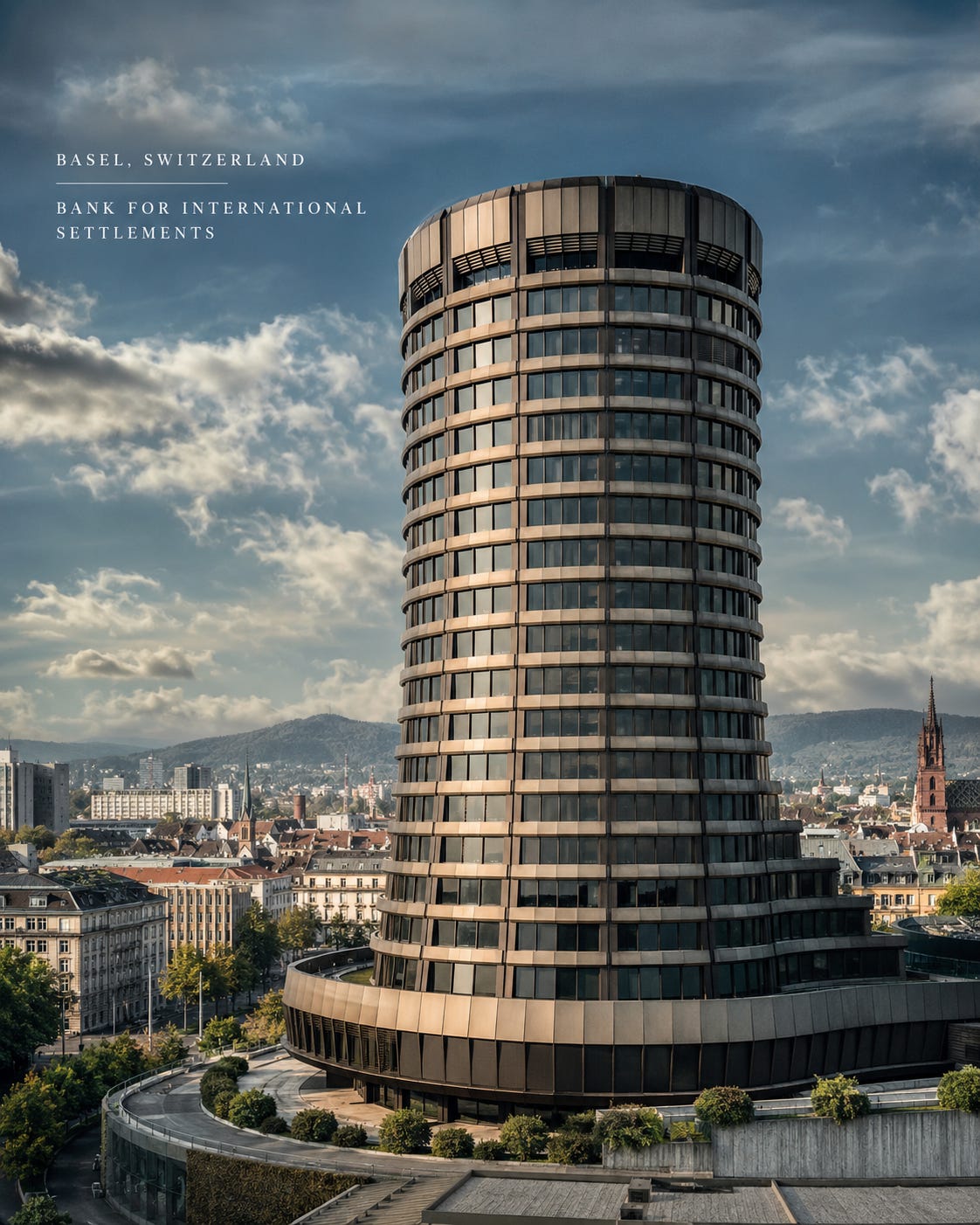
It hosts the Basel Committee on Banking Supervision, which writes the global capital rules every major bank must obey. It hosts the Financial Stability Board, the International Association of Insurance Supervisors, and the International Association of Deposit Insurers. It is currently building Project Nexus to interlink the domestic instant-payment systems of India, Malaysia, Thailand, the Philippines, and Singapore.
The current Chair of the Board, elected in May 2026, is Fabio Panetta, Governor of the Bank of Italy. The current General Manager who runs the institution day to day is Pablo Hernández de Cos, former Governor of the Bank of Spain, who chaired the Basel Committee on Banking Supervision before being promoted to run the entire institution. In a separate but equally telling move, Christine Lagarde of the European Central Bank took over from former Fed Chair Jerome Powell in May 2026 as Chair of the BIS Global Economy Meeting and Economic Consultative Committee, the two most important bimonthly gatherings of central bank governors. The American Fed Chair, now Kevin Warsh, sits on the Board as one of eighteen directors. The American Fed Chair has never held the BIS Chair seat. The American Fed Chair never will.
Most people have never heard the BIS’s name. Every banker on earth lives under its rules.
🛡️ Sovereign immunity: still untouchable
Yes. The immunities are not only intact, they have expanded.
The legal foundation is treaty, not charter. The 1930 Hague Convention created the bank. The 1936 Brussels Protocol reinforced its diplomatic status. The 1987 Headquarters Agreement with Switzerland nailed down the modern immunity package. Under that agreement, the BIS premises are inviolable. Swiss authorities cannot enter without permission from the BIS General Manager. The BIS and its officials are immune from Swiss jurisdiction in their official functions. Its assets cannot be seized, requisitioned, or confiscated. Its officials enjoy diplomatic privileges. It pays no Swiss tax.
That same treaty-based immunity package has been ported, country by country, to every new Innovation Hub. Singapore granted it in 2020. London granted it in 2021. Sweden granted it in 2021. France granted it for the Paris and Frankfurt Eurosystem Centre. Canada granted it in 2024 for the Toronto hub. Each host country agreement extends inviolability of premises, archives, and communications, plus immunity for officials performing their duties.
In plain English. The institution that processed Reichsbank gold in 1939, Soviet gold in 1969, and 4.5 trillion dollars in emergency Fed swaps in 2008, still operates in a legal category that no national court can touch. It is the only financial body on earth with that status. It is older than the IMF, older than the World Bank, older than the United Nations itself. And it sits above all of them in legal protection because, unlike them, it was born of treaty before any of them existed.
Part 5 of this series follows the immunity package as it travels into the next financial architecture. Project Nexus. The CBDC pilots in Toronto, Stockholm, and Frankfurt. The programmable dollar being built right now in plain sight with no Congressional vote in any country. If you want to know what comes after the swap lines, that is the closer.
🎯 The pattern, fully revealed
Look at what you are seeing now.
The British financed both sides of the Civil War in 1862. The BIS cleared Reichsbank gold to buy Swedish iron in 1940. The BIS quietly banked Soviet gold sales through the 1960s. The Eurodollar market grew because communists were scared of New York. The Fed became the lender of last resort to European banks in 2008 because European banks had over-leveraged in dollars they could not print. The BIS diagnosed the gap, coordinated the response, and supported the flows.
Same institution. Same logic. Same century-spanning pattern.
The American taxpayer ultimately stands behind the global dollar system. The Federal Reserve issues the dollars. The BIS coordinates which foreign banks get them and on what terms. The European banks borrow them, profit from them, and pay them back into the same network. Not one voter in Ohio was ever asked whether their currency should be the world’s emergency liquidity backstop. The answer was decided in Basel.
When people ask why ordinary Americans lost their homes in 2009 while not one major bank executive went to prison, this is part of the answer. The bailout was bigger than the foreclosure crisis. It just happened in a language the average citizen was never taught to read.
🌱 Lessons: neutrality is a ledger, not a slogan
When a “neutral” institution lets stolen gold be used to fund bombers, neutrality becomes complicity. The BIS gave Nazi Germany not just liquidity, but legitimacy. It later gave the Soviet Union the same service in a different currency. It gave European banks the same service in 2008 in trillions of dollars. If history is any guide, it will give the next regime the same service in the next currency.
This is not a moral failure of one bank. It is the operating system of international finance. Capital flows toward yield, not toward virtue. Once you accept that, the world becomes legible.
🪧 Turn pain into power: how this knowledge changes your life
Most people read history like this and feel small. Don’t. You just got handed something worth more than most MBAs charge for. Here is how to spend it.
Stop being shocked by hypocrisy. Start pricing it in. Every institution that calls itself neutral is running a flow. Banks, foundations, universities, regulators, ratings agencies, news outlets, even your employer. They each have a ledger somewhere. Once you stop expecting them to act on stated values and start tracking their actual flows, you will make better decisions in every negotiation, every job change, every investment, and every vote.
Diversify out of the dollar trap without panicking. The Fed is the lender of last resort to European banks. The BIS coordinates which foreign banks get printed dollars and when. That means the U.S. dollar is structurally diluted every time there is a global crisis, because the rescue is paid for in your purchasing power. You do not need to become a doomsday prepper. You just need to stop holding 100 percent of your savings in one currency or one asset class. A reasonable allocation across U.S. equities, foreign equities, physical gold or silver, productive real estate, and a small position in hard-cap assets like Bitcoin protects you from the next 2008-scale rescue. The point is not to predict the next crisis. The point is to survive it without losing a decade of compounding.
Read the rules of the game your money lives inside. The Basel capital rules determine which assets your pension fund and 401(k) manager are allowed to hold, how much they must reserve against them, and which sovereign bonds count as risk-free. You did not vote on those rules. Your retirement is allocated according to them anyway. Spend one Saturday this year reading your 401(k) prospectus and the fact sheets of your top three holdings. Ask what would happen to each fund if Treasuries lost their risk-free status. If you cannot get an answer, that is an answer.
Watch the swap lines like you watch the weather. The Federal Reserve publishes the H.4.1 release every Thursday at 4:30 p.m. Eastern. The “Central bank liquidity swaps” line on table 1 tells you, in real time, when foreign banks are running out of dollars. When that number jumps from near zero into the billions, something is breaking in Europe or Japan, and equity volatility usually follows within weeks. This is a free early-warning indicator most retail investors have never heard of. Bookmark it.
Take the lesson into your own work. Capital flows toward yield, not virtue. So do customers, employees, attention, and trust. If you run a business, sell a service, or build an audience, stop expecting people to reward your good intentions and start engineering visible value into every transaction. The BIS lasted a century because it made itself indispensable to every central bank on earth, including the ones that were supposed to dismantle it. Be indispensable. The reputation will follow the value, not the other way around.
Free your mind from the false binary. Once you see that bankers funded both sides of the Civil War, both sides of World War II, and both sides of the Cold War, you stop falling for partisan rage cycles designed to keep you emotionally invested in someone else’s profit margin. That alone is worth thousands of hours of mental health. Anger that is engineered to keep you watching the other team is anger that is being monetized at your expense. Spend that energy building your own ledger instead. Your sleep will improve within a week.
Teach one person. Knowledge that stays in your head depreciates. Knowledge you teach to your spouse, your kid, a friend at the gym, or a colleague over coffee compounds. The next time someone tells you central banks are boring or that 2008 was just a housing crisis, you have the receipts. Share them. The architecture of power weakens slightly every time one more person can read it.
🏰 Final thought
Without the BIS, Hitler’s Germany would have been diplomatically isolated, financially weakened, and strategically stalled. The Blitz, the iron imports, and much of the Nazi economy depended on one thing. Gold liquidity. And the BIS turned looted metal into power.
Twenty years later it turned Soviet gold into Western groceries. Forty years after that it became the rule-maker for every commercial bank on earth. In 2008 it diagnosed and coordinated the largest dollar bailout in human history. Almost a century on from its founding, no court anywhere can open its books without permission. The treaty that created it in 1930 has outlived every government that signed it.
The next time someone tells you central banks are boring, remind them. One neutral balance sheet can fund a world war, bankroll its enemy in the next one, clear the gold of every regime in between, and quietly underwrite the modern global banking system. All from a round tower in Basel.
You don’t need a security clearance or a finance degree to see this. You need the willingness to read the ledger. Anyone who can read an annual report can decode the architecture of power. That is the quiet superpower of the citizen investigator. The receipts are public. The board lists are public. The host country agreements are public. The 4.5 trillion in 2008 swap flows is on the Federal Reserve’s own balance sheet. The diagnosis is in the BIS Quarterly Review, archived and searchable.
You have that patience. Use it. The next institution that calls itself neutral is waiting for someone like you to check the books. You are more capable of this than anyone has ever told you. Read one annual report this week. Then read one more. The architecture of power is not hidden. It is just unread.
If you’re feeling like this info is essential, please support this free section.
Anything helps for the work spent connecting the dots on the documented truth.
Available Now 👇
Part 2: The Enfield Rule. The deeper truth about how the City of London ran the American Civil War from both ends. British rifles to both armies. British wool to both uniforms. Rothschild loans to both treasuries. Lloyd’s insuring both fleets. The blockade runners who got rich because the blockade existed. If you thought the Civil War was American, Part 2 will change your mind in twenty minutes. Subscribe to get it on arrival.
🧭 Coming next in The Sovereign Immunity Series
Parts 3, 4, and 5 follow. The 2008 deep dive, the governance map, and the next architecture. Five pieces. One bank in Basel. The full picture of Sovereign Immunity only assembles if you read all five.
The Sovereign Immunity Series Navigation
Part 1 => Part 2 => Part 3 => Part 4 => Part 5
❓ Before you go:
If bankers always sell to both sides, who is the real winner of every war?
Drop your answer in the comments. I read every one. 👇
📚 References
Bank for International Settlements. (1930). Constituent Charter of the Bank for International Settlements and Statutes. The Hague Convention.
Bank for International Settlements. (1936). Brussels Protocol regarding the immunities of the Bank for International Settlements.
Bank for International Settlements. (1941). Eleventh annual report, 1st April 1940 to 31st March 1941. Bank for International Settlements.
Bank for International Settlements. (1942). Twelfth annual report, 1st April 1941 to 31st March 1942. Bank for International Settlements.
Bank for International Settlements. (1945). Fifteenth annual report, 1st April 1944 to 31st March 1945. Bank for International Settlements.
Bank for International Settlements. (1997). Note on gold operations involving the BIS and the Reichsbank, 1939-1945. Bank for International Settlements.
Bank for International Settlements. (1987). Headquarters agreement between the Swiss Federal Council and the Bank for International Settlements. Bank for International Settlements Basic Texts.
LeBor, A. (2013). Tower of Basel: The shadowy history of the secret bank that runs the world. PublicAffairs.
Toniolo, G., & Clement, P. (2005). Central bank cooperation at the Bank for International Settlements, 1930-1973. Cambridge University Press.
United Nations Monetary and Financial Conference. (1944). Proceedings and documents of the United Nations Monetary and Financial Conference, Bretton Woods, New Hampshire. United States Department of State.
Steil, B. (2013). The battle of Bretton Woods: John Maynard Keynes, Harry Dexter White, and the making of a new world order. Princeton University Press.
United States Department of State, & Eizenstat, S. E. (1997). U.S. and allied efforts to recover and restore gold and other assets stolen or hidden by Germany during World War II. U.S. Government Printing Office.
Swiss Federal Council. (2002). Final report of the Independent Commission of Experts Switzerland-Second World War (Bergier Commission). Pendo Verlag.
Schenk, C. R. (1998). The origins of the Eurodollar market in London, 1955 to 1963. Explorations in Economic History, 35(2), 221 to 238.
Burn, G. (1999). The state, the City and the Euromarkets. Review of International Political Economy, 6(2), 225 to 261.
Bordo, M. D., & Eichengreen, B. (Eds.). (1993). A retrospective on the Bretton Woods system: Lessons for international monetary reform. University of Chicago Press.
Bailey, D. W. (1972). British arms exports to the American Civil War: The Enfield rifle and the Atlantic arms trade. Arms and Armour Press.
Pryor, A. J. (2008). The Confederate Ordnance Department and the British arms trade. Civil War History, 54(4), 393 to 419.
United Kingdom Parliament, House of Lords. (2021). Bank for International Settlements (Immunities and Privileges) Order 2021. Hansard.
McGuire, P., & von Peter, G. (2009). The U.S. dollar shortage in global banking. BIS Quarterly Review, March, 47 to 63.
McGuire, P., & von Peter, G. (2008). International banking activity amidst the turmoil. BIS Quarterly Review, June, 31 to 43.
Moessner, R., & Allen, W. A. (2010). Central bank co-operation and international liquidity in the financial crisis of 2008 to 9 (BIS Working Paper No. 310). Bank for International Settlements.
Tooze, A. (2018). Crashed: How a decade of financial crises changed the world. Viking.
United States Government Accountability Office. (2011). Federal Reserve System: Opportunities exist to strengthen policies and processes for managing emergency assistance (GAO-11-696). U.S. Government Accountability Office.
Goldberg, L. S., Kennedy, C., & Miu, J. (2011). Central bank dollar swap lines and overseas dollar funding costs. Federal Reserve Bank of New York Economic Policy Review, 17(1), 3 to 20.
Note, The Federal Reserve’s questionable legal basis for foreign central bank liquidity swaps. (2019). Columbia Law Review, 119(8), 2255 to 2294.
Bank for International Settlements. (2024). Host country agreement between the Government of Canada and the Bank for International Settlements. Bank for International Settlements.
Bank for International Settlements. (2024). Project Nexus: Enabling instant cross-border payments. BIS Innovation Hub.
Images in this piece are AI generated for editorial purposes. The writing was drafted from my own research and interwoven thought, audited and edited through Claude, Gemini, and ChatGPT workflows.
If you have an idea for an article, or want me to write something for you, I am available to work for you. If something in mainstream media does not sit right, or you cannot quite make sense of it, let my fresh eyes break it down in a way that finally clicks. And if your company needs an outside perspective to find the systemic problems and efficiency gaps that insiders are too close to see, that is my expertise. I see the connections others miss.
In any conflict, funded by banks,
Bankers win. Both sides lose.
Thats the Tl;dr version
Thanks for posting Rolf… for those of us who aspire to learn from history and not repeat its mistakes, I am truly indebted💜
This is massive amounts of research and connecting the dots. I sooo appreciate your work and steadfast belief that history leads us to the present.